Welcome to Shandong Teda Steel Structure Co., Ltd.
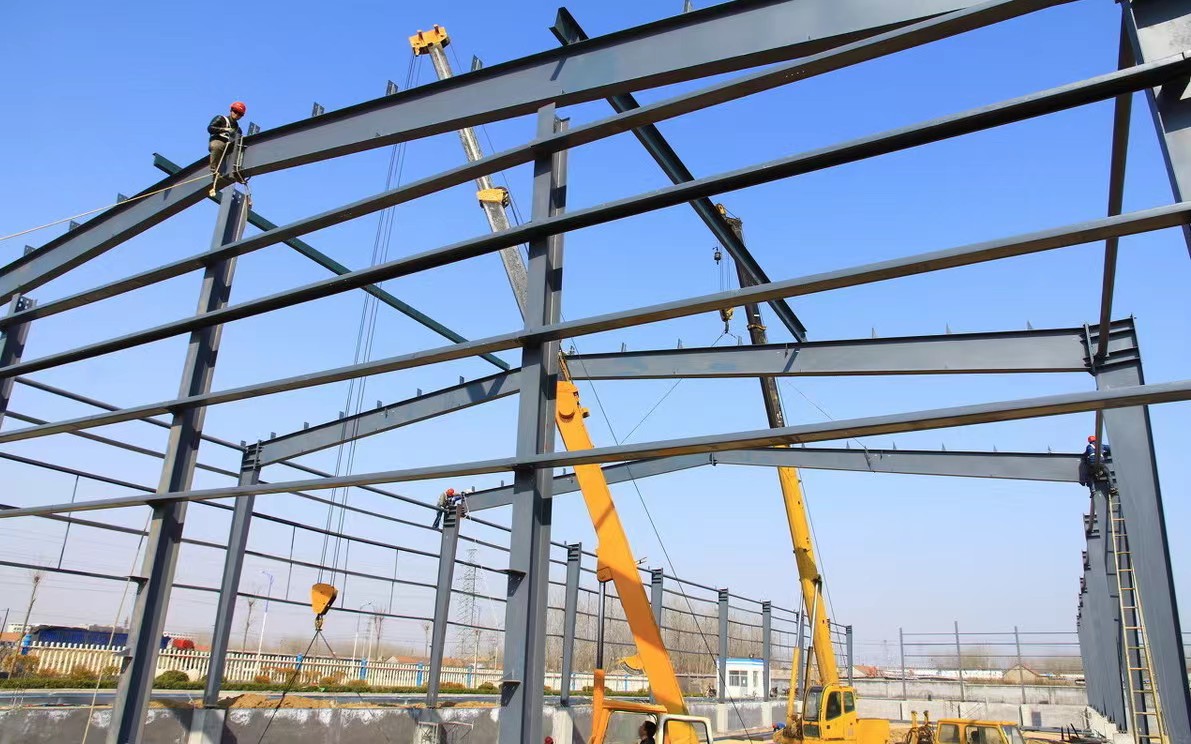
Steel structure construction is widely applied in industrial plants, high-rise buildings, and large-span venues due to its advantages of high efficiency, light weight, and good seismic performance. However, during the construction process, various problems may arise due to factors such as material quality, construction technology, operational standards, and environmental conditions. These problems not only affect the construction progress but also may endanger the structural safety and service life of the project. This article summarizes the common problems in steel structure construction and provides corresponding scientific and effective solutions.
Common Phenomena: The mechanical properties (tensile strength, yield strength) of steel do not meet the design requirements; the steel surface has defects such as cracks, scratches, rust, and inclusions; the dimensional deviation of steel sections exceeds the allowable range.
Solutions: 1. Strictly implement the incoming inspection system for steel materials. Check the quality certificate, performance test report of the steel, and conduct re-inspection of key performance indicators in accordance with national standards. Unqualified steel materials shall not enter the construction site. 2. For steel surfaces with slight rust and scratches, use grinding tools to polish them until the metal luster is exposed; for defects such as deep cracks and serious inclusions, mark them in time and contact the supplier for replacement or disposal. 3. For steel sections with dimensional deviations that exceed the allowable range, conduct secondary processing and correction if the deviation is small; if the deviation is too large to be corrected, return them to the factory for replacement.
Common Phenomena: Bolts (high-strength bolts, ordinary bolts) have unqualified hardness, thread damage, or incomplete accessories; welding materials (welding rods, welding wires, flux) do not match the steel grade; the dimensional accuracy of connecting plates is unqualified.
Solutions: 1. For bolts, check the quality certificate and conduct hardness testing and thread inspection. Damaged bolts and incomplete accessories shall be sorted out and replaced. High-strength bolts shall also undergo torque coefficient or pre-tension force testing. 2. Strictly select welding materials that match the steel grade, and check the storage conditions of welding materials (prevent moisture, rust, and expiration). Unqualified or expired welding materials shall not be used. 3. For connecting plates with unqualified dimensional accuracy, reprocess them to meet the design requirements; if the processing error is too large, re-manufacture them.
Common Phenomena: The dimensional deviation of steel components after cutting exceeds the standard; the cut section has burrs, unevenness, or thermal deformation; the bevel angle of the welding joint does not meet the design requirements.
Solutions: 1. Before cutting, calibrate the cutting equipment (flame cutting machine, plasma cutting machine, shearing machine) to ensure its accuracy. For important components, use CNC cutting equipment to improve cutting precision. 2. After cutting, remove the burrs and slag on the section in time. For sections with unevenness, polish them flat. 3. Strictly control the bevel angle during cutting. Use angle gauges to check at any time. If the angle is unqualified, reprocess the bevel.
Common Phenomena: Deviation in the assembly position of components; deformation of components due to improper clamping force during assembly; poor fit between connecting parts (such as bolts and bolt holes not aligned).
Solutions: 1. Before assembly, set up a precise assembly platform and mark the assembly lines accurately. Use positioning fixtures to fix the components during assembly to ensure the assembly position is correct. 2. Control the clamping force reasonably during assembly to avoid excessive force causing component deformation. For components that have been deformed, use mechanical correction or thermal correction methods to restore them to the correct shape (note that thermal correction should avoid overheating and damage to the steel structure). 3. For bolt holes that are not aligned, use reaming tools to expand the holes appropriately (ensure the expansion range meets the standard requirements); if the deviation is too large, re-drill the holes after welding reinforcement, and shall not forcibly insert bolts.
Common Phenomena: Welding defects such as cracks, porosity, slag inclusion, incomplete penetration, and undercut in the weld; the weld size (height, width) does not meet the design requirements; welding deformation.
Solutions: 1. Before welding, strictly clean the welding joint (remove oil stains, rust, moisture, etc.), and select the appropriate welding process parameters (welding current, voltage, welding speed) according to the steel grade and thickness. 2. For welding defects: Cracks should be chiseled or ground off completely, and then re-welded; porosity and slag inclusion should be cleaned up the defective part and re-welded; incomplete penetration should be handled by increasing the welding current or adjusting the bevel angle and re-welding; undercut should be filled and repaired by welding. 3. Control the weld size strictly, and check with welding gauges during the welding process. For welds that do not meet the requirements, repair them by welding. 4. Adopt reasonable welding sequences (such as symmetric welding, segmented welding) to reduce welding deformation. For deformed workpieces after welding, correct them in time.
Common Phenomena: The hoisting position of components is deviated; components collide and damage during hoisting; the stability of components is poor during hoisting (easy to tilt or swing).
Solutions: 1. Before hoisting, formulate a detailed hoisting plan, determine the hoisting points and hoisting sequence, and check the performance of the hoisting equipment (crane, wire rope, hook) to ensure it is in good condition. 2. Use positioning ropes to control the swing of components during hoisting, and arrange special personnel to command the hoisting (the commander must have professional qualifications). 3. After the component is hoisted in place, temporarily fix it first, and then perform precise adjustment. Use level gauges, theodolites and other instruments to check the position and verticality of the component. After meeting the requirements, carry out formal fixing.
Common Phenomena: The tightening torque of high-strength bolts does not meet the requirements; ordinary bolts are not tightened in place; bolts loosen due to vibration during construction.
Solutions: 1. For high-strength bolts, use a torque wrench (calibrated before use) to tighten them in strict accordance with the specified torque. Adopt the "two-step tightening method" (initial tightening and final tightening) to ensure the pre-tension force of the bolts. After tightening, mark them to avoid missing tightening or over-tightening. 2. For ordinary bolts, use a wrench to tighten them in place, and check whether the bolt heads are closely attached to the connecting plate. For bolts in vibration-prone positions, use anti-loosening measures (such as spring washers, lock nuts). 3. Regularly recheck the tightness of bolts during the construction process, and re-tighten any loose bolts in time.
Common Phenomena: The temporary support system is not firm; the installation sequence is unreasonable, leading to uneven stress on the structure and poor overall stability; the structure is unstable due to strong wind, vibration and other environmental factors.
Solutions: 1. Set up a firm temporary support system (such as scaffolding, support rods) during installation. The support system should be calculated and designed to ensure it can bear the weight of the components and construction loads. 2. Strictly follow the designed installation sequence. Generally, install the main structure first, then the secondary structure; install symmetrically to avoid uneven stress. 3. Pay attention to weather changes. Stop hoisting and installation operations in severe weather such as strong winds (wind force above level 6) and heavy rains. Strengthen the fixation of installed components to prevent structural instability.
Common Phenomena: Water leakage at the joints of roof and wall panels; poor sealing at the overlapping parts of panels; deformation of panels affects the sealing performance.
Solutions: 1. Select high-quality sealing materials (sealing tape, sealant) that are compatible with the panel materials. Check the expiration date and quality of the sealing materials before use. 2. Strictly follow the installation process for panel installation. Ensure the overlapping width of panels meets the requirements, and compact the sealing tape at the joints. For the sealant, apply it evenly and smoothly, without gaps or bubbles. 3. For deformed panels, correct them first or replace them with new ones. After installation, conduct a water test (artificial water spraying or natural rain observation) to check the waterproof effect. If water leakage is found, timely repair the sealing parts.
Common Phenomena: Construction personnel do not use safety protection equipment (safety belts, safety nets) correctly; the temporary operation platform is not firm; objects fall from high altitudes.
Solutions: 1. Strengthen safety training for construction personnel, and require them to correctly wear and use safety protection equipment (safety belts must be hung high and used low). 2. Check and accept the temporary operation platform before use to ensure its firmness and stability. Set up guardrails and anti-skid measures on the platform. 3. Set up safety warning signs in high-altitude operation areas, and set up safety nets below. Prohibit throwing construction materials and tools from high altitudes; use tool bags to store tools.
Common Phenomena: Illegal use of electrical equipment; damaged electrical wires and poor insulation; electrical equipment is not grounded or connected to zero properly.
Solutions: 1. Electrical operations must be performed by professional electricians with qualifications. Strictly abide by electrical operation specifications, and prohibit illegal wiring and use of electrical equipment that does not meet the requirements. 2. Regularly check the electrical wires and equipment. Replace damaged wires and electrical equipment in time. Ensure the insulation performance of electrical equipment meets the standard. 3. Electrical equipment must be correctly grounded or connected to zero to prevent electric leakage. Set up leakage protectors in electrical circuits to ensure their normal operation.
The common problems in steel structure construction involve multiple links such as material preparation, component processing, and on-site installation. To effectively solve these problems, it is necessary to establish a sound quality management system and safety management system. Strictly control each construction link, strengthen the training of construction personnel, improve their professional quality and operational skills, and conduct regular inspections and re-inspections during the construction process. Only in this way can the quality and safety of steel structure projects be ensured, the construction progress be promoted smoothly, and the service life of the steel structure be extended.

Copyright © 2023 Shandong Taida Steel Structure All Rights Reserved. XML Maps
Technical Support:Shandong Taida Steel Structure Co., Ltd
Scan to ChatHotline
