Welcome to Shandong Teda Steel Structure Co., Ltd.
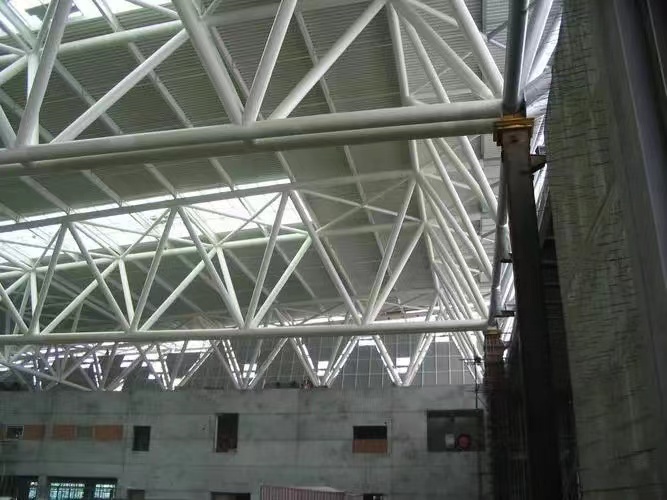
Tubular truss steel structure is a spatial load-bearing structure composed of circular, square or rectangular steel tubes connected by welding or bolted joints. Its unique composition form, which takes full advantage of the mechanical properties of tubular sections, makes it have significant differences from traditional truss structures and is widely recognized in the field of large-span and spatial buildings. The following are its main characteristics and core advantages.
Excellent Mechanical Performance of Tubular Sections: Compared with open-section components (such as I-beams and angle steels), tubular sections have uniform cross-sectional properties and strong resistance to axial compression, bending and torsion. The circular tube section, in particular, has the smallest wind resistance coefficient, which can effectively reduce wind load effects, making the structure more suitable for large-span and high-altitude applications. In addition, the closed section of the steel tube can avoid the corrosion of internal materials caused by rainwater and moisture, improving the durability of the structure.
Reasonable Force Transmission and Light Structural Weight: The tubular truss is composed of upper chord, lower chord and web members, forming a triangular or polygonal stable unit. The force transmission path is clear and direct, and the internal force of each member is mainly axial tension or compression, which can give full play to the high strength of steel materials. Under the same load-bearing and span conditions, the weight of the tubular truss steel structure is significantly lighter than that of reinforced concrete structures and even traditional open-section steel truss structures, which greatly reduces the burden on the foundation.
Flexible Spatial Form and Good Aesthetic Effect: Tubular truss steel structure can be designed into various spatial forms according to architectural needs, such as arc, hyperboloid, cantilever and other complex shapes. The smooth lines of the steel tube and the light structure make the building have a strong sense of modernity and artistry. It can not only meet the functional requirements of large-span space but also enhance the aesthetic value of the building, which is widely used in landmark buildings.
Good Seismic and Fatigue Performance: Steel materials have excellent ductility and toughness, and the tubular truss structure forms a stable spatial force system through the connection of multiple members. During earthquakes, the structure can absorb and dissipate seismic energy through plastic deformation of members and joints, avoiding sudden collapse. At the same time, the uniform stress distribution of the tubular section makes the structure have good fatigue resistance, which is suitable for buildings with long service life and frequent dynamic loads (such as stadiums with large flow of people).
Large Span Capacity: Benefiting from the excellent mechanical properties of steel tubes and the reasonable structural system, the tubular truss steel structure can easily achieve large-span spatial coverage. The span can reach 30-100 meters or even larger, which is difficult to achieve with traditional structures. This advantage makes it the first choice for buildings that require large unobstructed spaces.
High Construction Efficiency: Most components of the tubular truss steel structure are prefabricated in factories, including the cutting, bending, welding and surface treatment of steel tubes. The factory prefabrication has high precision, stable quality and can realize mass production, which greatly shortens the on-site construction time. On the construction site, only assembly and connection work is needed, and with the assistance of professional hoisting equipment, the construction progress can be significantly accelerated.
Strong Adaptability to Complex Environments: Tubular truss steel structure has good corrosion resistance (after professional anti-corrosion treatment) and can adapt to various harsh environmental conditions, such as coastal areas with high salt spray, cold areas with low temperature and humid areas with high rainfall. In addition, the light weight of the structure makes it suitable for construction in areas with poor geological conditions, reducing the difficulty and cost of foundation construction.
Environmentally Friendly and Recyclable: Steel is a fully recyclable green building material. At the end of the service life of the tubular truss steel structure, most of the steel tube components can be recycled and reused after simple treatment, which reduces the generation of construction waste. Moreover, the factory prefabrication method reduces on-site construction pollution such as dust, noise and sewage, in line with the concept of low-carbon and environmental protection in modern construction.
Convenient Maintenance and Renovation: The surface of the tubular truss steel structure is smooth, which is easy to clean and inspect. If local components are damaged or the use function of the building needs to be changed, the steel tubes can be easily cut, welded and replaced. The renovation process will not cause major damage to the original structure, and the construction period of renovation is short, which can better meet the changing needs of users.
Due to its large span capacity, flexible spatial form and excellent comprehensive performance, tubular truss steel structure is widely used in various large-span, large-space and landmark buildings. The main application scenarios are as follows:
This is the most typical application field of tubular truss steel structure. It is widely used in stadiums, gymnasiums, swimming pools, auditoriums, exhibition halls, theaters and other buildings. For example, the roof structures of large stadiums (such as football stadiums and track and field stadiums) often adopt large-span tubular truss structures, which can cover the entire competition field and stands to form an unobstructed large space; the roofs of exhibition halls and convention centers use tubular truss structures to achieve large-area coverage, facilitating the display and layout of exhibits; the auditoriums and theaters use the flexible spatial form of tubular trusses to match the architectural shape and meet the acoustic and lighting requirements.
In transportation hub buildings that require large-span and open spaces, such as airports, high-speed rail stations, railway stations and bus terminals, tubular truss steel structure is widely used. For example, the roof canopies of airport terminals and high-speed rail stations need to cover large areas such as waiting halls and platforms. The tubular truss structure can not only meet the span requirement but also have a beautiful appearance, which enhances the image of the transportation hub; the canopies of platform corridors and pedestrian overpasses also often use tubular truss structures due to their light weight and quick construction.
In industrial and logistics buildings that require large-span workshops, warehouses and logistics centers, tubular truss steel structure is also widely used. For example, large-scale machinery manufacturing workshops, aircraft maintenance workshops and automobile assembly workshops need large unobstructed spaces to place equipment and carry out production operations. The tubular truss structure can meet the span and load-bearing requirements; logistics warehouses and distribution centers use tubular truss roofs to achieve large-area coverage, facilitating the storage and transportation of goods and the operation of large logistics equipment (such as gantry cranes).
Tubular truss steel structure, with its flexible spatial form and beautiful appearance, has become an important choice for landmark and landscape buildings. For example, the roofs of city squares, cultural and art centers, memorial halls and other landmark buildings often adopt complex-shaped tubular truss structures to show the unique architectural style; landscape buildings such as pedestrian bridges, viewing platforms and pavilions in scenic spots also use tubular truss structures, which not only meet the functional requirements but also integrate with the natural environment to form a beautiful landscape.
In addition, tubular truss steel structure is also used in some special buildings, such as large-span greenhouses, coal storage yards, and temporary large-scale venues. For example, large-span agricultural greenhouses use tubular truss structures to achieve large-area coverage, providing sufficient space for crop growth; coal storage yards and other bulk material storage yards use tubular truss structures to build enclosed canopies, which can prevent dust pollution and protect the environment; temporary large-scale venues (such as exhibition pavilions for sports events and cultural activities) use tubular truss structures due to their quick assembly and disassembly, which can be reused after the event.
The construction of tubular truss steel structure is a complex systematic project involving factory prefabrication and on-site assembly. It requires strict control of each link to ensure the construction quality, safety and progress. The specific construction steps are as follows:
Pre-construction preparation is the foundation of the entire construction project, which directly affects the smooth progress of the project. The main contents include:
Design Review and Drawing Disclosure: The construction unit, design unit and supervision unit jointly review the construction drawings, focusing on checking the rationality of the truss structure system, the reliability of node design, and the consistency of component dimensions. The design unit conducts drawing disclosure to the construction team, explaining the design intention, key construction points, technical requirements and quality control standards.
Site Investigation and Planning: Conduct a detailed investigation of the construction site to understand the geological conditions, hydrological conditions, surrounding environment (such as nearby buildings, power lines and roads) and meteorological conditions. Based on the investigation results, formulate a reasonable construction plan, plan the layout of the construction site (such as component storage area, assembly area, hoisting area and office area), and do a good job in site leveling and drainage.
Material Preparation and Inspection: Purchase steel tubes, connectors (such as high-strength bolts, welding materials), anti-corrosion coatings and other materials in accordance with the design requirements and national standards. All materials must be accompanied by product qualification certificates and inspection reports. Before entering the site, sampling inspection shall be carried out on the steel tubes (such as mechanical property test, chemical composition analysis) and connectors to ensure that the material quality meets the requirements. At the same time, prepare construction machinery and equipment (such as cranes, welding machines, pipe bending machines, cutting machines, measuring instruments) and carry out debugging and maintenance to ensure their normal operation.
Construction Scheme Formulation and Personnel Training: Formulate a detailed construction organization design and special construction schemes (such as truss prefabrication scheme, on-site hoisting scheme, welding construction scheme and anti-corrosion construction scheme). Clarify the construction process, construction sequence, quality control points, safety protection measures and construction schedule. Conduct technical training and safety education for construction personnel, especially for professional operators (such as welders, hoisting workers and measuring personnel), to ensure that they are familiar with the operating procedures and technical requirements.
The prefabrication quality of tubular truss components directly determines the overall quality of the structure. The main steps are:
Steel Tube Cutting and Blanking: According to the component processing drawings, use professional cutting equipment (such as plasma cutting machine, flame cutting machine) to cut the steel tubes. During cutting, strictly control the cutting accuracy (such as length, bevel angle) to ensure that the size of the steel tube meets the assembly requirements. After cutting, remove the burrs and slag on the end of the steel tube.
Steel Tube Bending and Forming: For curved steel tubes in the truss, use a pipe bending machine to bend and form them according to the design curve. During the bending process, control the bending radius and bending angle to avoid excessive deformation or damage to the steel tube. After bending, check the shape and size of the steel tube and correct it if there is any deviation.
Truss Node Fabrication: The node is the key part of the tubular truss, which bears the connection function between multiple steel tubes. Common node forms include welded hollow spherical nodes, bolted spherical nodes and direct welded nodes. For welded hollow spherical nodes, first cut and weld the steel plates into hollow spheres, and then process the connecting holes according to the direction and angle of the truss members; for bolted spherical nodes, process the spherical shell and bolt holes in the factory, and assemble the bolts and sleeves.
Truss Assembly: Assemble the processed steel tubes and nodes into truss components on the dedicated assembly platform. First, set out the lines on the assembly platform according to the truss design drawings, mark the position of each member and node. Then, place the nodes and steel tubes in sequence, adjust their positions and angles, and fix them with positioning fixtures. During assembly, use measuring instruments (such as total station, level gauge) to check the assembly accuracy (such as truss length, height, span and node position) to ensure that the deviation meets the requirements.
Welding Construction: Weld the assembled truss components. According to the type of steel tube and node, select the appropriate welding method (such as gas shielded welding, submerged arc welding) and welding materials. Strictly implement the welding process parameters to ensure the welding quality. During welding, control the welding temperature and welding speed to avoid welding defects such as cracks, porosity and incomplete fusion. After welding, clean the welding slag and spatter, and check the welding seam. For key nodes and important welds, non-destructive testing (such as ultrasonic testing, X-ray testing) shall be carried out to ensure the welding quality meets the standards.
Surface Treatment and Anti-Corrosion Coating: Carry out surface treatment on the welded truss components to remove rust, oil stains, oxide scales and other impurities. Common surface treatment methods include sandblasting derusting and pickling derusting. The derusting grade shall meet the design requirements. After surface treatment, apply anti-corrosion coating in a timely manner. The coating shall be applied evenly, with the specified thickness and number of layers. After the first coat is dry, apply the second coat. For truss components used in harsh environments (such as coastal areas), an additional anti-corrosion layer or galvanizing treatment can be adopted to improve the anti-corrosion performance. After the coating is completely dry, inspect the coating quality, and touch up the missing coating and damaged parts.
Component Inspection and Marking: Conduct a comprehensive inspection of the prefabricated truss components, including dimension inspection, welding quality inspection, coating quality inspection and appearance quality inspection. For components that meet the requirements, mark the component number, weight, installation position, hoisting direction and other information to facilitate on-site storage, transportation and assembly.
Transport the prefabricated truss components from the factory to the construction site. During transportation, take protective measures (such as using special fixtures, wrapping with protective film) to prevent deformation, collision damage and coating damage of the components. After arriving at the site, place the components in the designated storage area. The storage area shall be flat, dry and well-drained, and the components shall be padded with sleepers to avoid direct contact with the ground, preventing corrosion and deformation. For large truss components, special supports shall be set up to ensure their stability during storage.
On-site assembly and hoisting are the core links of tubular truss steel structure construction, which require strict control of construction accuracy and safety. The main steps are:
Measurement and Setting Out: According to the construction drawings and control points, use professional measuring instruments (such as total station, theodolite) to carry out measurement and setting out on the construction site. Determine the installation position, elevation and axis of the truss support (such as concrete column top, steel column top), and set up positioning markers and control lines to ensure the accuracy of truss installation.
Installation of Support Components: Install the truss support components (such as support seats, bearing plates) on the foundation or column top according to the setting out position. Adjust the elevation and levelness of the support components, and fix them firmly. Check the position and accuracy of the support components to ensure they meet the design requirements.
Truss Hoisting: According to the weight, span and on-site construction conditions of the truss components, select the appropriate hoisting equipment (such as crawler cranes, tower cranes) and hoisting methods (such as integral hoisting, segmented hoisting, sliding hoisting). Before hoisting, install lifting lugs on the truss components according to the hoisting scheme. The position and number of lifting lugs shall be determined through calculation to ensure the truss is balanced during hoisting. During hoisting, command the operation uniformly, control the lifting speed and stability, and avoid collision between the truss and other objects. When the truss is hoisted to the installation position, adjust its position and elevation through pulleys, jacks and other tools, and align it with the support components.
Truss Connection and Fixing: After the truss is aligned in place, connect the truss with the support components and between truss segments (for segmented hoisting). The connection methods include high-strength bolt connection and welding connection. For high-strength bolt connection, ensure that the bolt holes are aligned, and tighten the bolts in the specified sequence and torque (initial tightening, re-tightening and final tightening). For welding connection, clean the welding area first, then carry out welding, and check the welding quality after welding. After the connection is completed, remove the hoisting equipment and temporary fixing devices.
Truss Adjustment and Inspection: Use measuring instruments to check the overall accuracy of the installed truss, including truss span, height, axis deviation, verticality and levelness. If there is any deviation, adjust it in time. Ensure that the truss is stable and the connection is firm. For large-span trusses, pre-arching can be carried out according to the design requirements to offset the deflection generated during use.
Installation of Bracing and Auxiliary Components: Install the bracing system (such as horizontal bracing, vertical bracing, diagonal bracing) according to the design requirements. The bracing system can improve the lateral stiffness and overall stability of the truss structure. At the same time, install auxiliary components such as purlins,檩条 supports and roof boarding brackets to prepare for the subsequent installation of roof and wall panels.
After the main truss structure is installed and accepted, install the roof and wall panels. The main steps are:
Roof Panel Installation: Transport the roof panels (such as color steel sandwich panels, aluminum-magnesium-manganese alloy panels) to the roof. Install the roof panels from one end to the other according to the design sequence. The connection between roof panels can adopt lap joint, snap joint or bolted connection. During installation, ensure that the lap joint is tight, and seal the lap joint with sealant to prevent water leakage. Install roof accessories such as roof ridges, gutters, downspouts and wind deflectors at the same time. Check the flatness and firmness of the roof panels to ensure the integrity and water tightness of the roof.
Wall Panel Installation: Install the wall panels from bottom to top. The wall panels are connected with the purlins or wall frames by self-tapping screws or rivets. During installation, ensure that the wall panels are flat, vertical and the joints are tight. Install door and window frames at the same time, and seal the gaps between the door and window frames and the wall panels with sealant to improve the thermal insulation, sound insulation and waterproof performance of the building.
After the completion of the entire tubular truss steel structure construction, carry out a comprehensive final inspection and acceptance to ensure that the project quality meets the design requirements and national relevant standards. The main contents include:
Appearance Quality Inspection: Check the appearance of truss components, welds, coatings, roof panels and wall panels. Check for defects such as deformation, cracks, welding spatter, coating peeling, roof water leakage and wall panel damage.
Dimension and Position Accuracy Inspection: Use measuring instruments to recheck the key dimensions and positions of the structure, including truss span, height, axis deviation, support elevation, column verticality and truss levelness. Ensure that all deviations are within the allowable range of the specification.
Connection Quality Inspection: Conduct a comprehensive inspection of the connection parts, including high-strength bolt torque inspection, anti-loosening measure inspection, welding seam non-destructive testing and node connection firmness inspection. Ensure that all connections are reliable and meet the design requirements.
Structural Stability and Safety Inspection: Check the bracing system, purlins and other components to ensure that they are installed in place and have sufficient stability. Conduct load test on the structure if necessary to verify its bearing capacity. Check the fire protection and anti-corrosion measures to ensure they meet the relevant specifications.
Construction Data Sorting and Acceptance: Sort out all construction data, including design documents, material inspection reports, component prefabrication records, on-site construction records, welding inspection reports, measurement records and safety inspection records. Submit the data to the supervision unit and owner for review. After passing the data review and on-site inspection, the project can be formally accepted and put into use.
Tubular truss steel structure, with its excellent mechanical performance, large span capacity, flexible spatial form and environmental protection advantages, has become an important structural form in modern large-span and spatial buildings. It is widely used in public cultural buildings, transportation hubs, industrial logistics and other fields, making an important contribution to the development of the construction industry. The construction of tubular truss steel structure involves multiple links such as pre-construction preparation, factory prefabrication, on-site hoisting and assembly. Only by strictly implementing the construction procedures, controlling the quality of each link and adhering to the safety production requirements can the construction quality and structural safety be ensured, and the excellent performance of the tubular truss steel structure be fully exerted.

Copyright © 2023 Shandong Taida Steel Structure All Rights Reserved. XML Maps
Technical Support:Shandong Taida Steel Structure Co., Ltd
Scan to ChatHotline

![[lsit:title]](/static/upload/image/20230418/1681806890691293.jpg)
![[lsit:title]](/static/upload/image/20230418/1681799010587461.jpg)
![[lsit:title]](/static/upload/image/20230419/1681884718686743.jpg)