Welcome to Shandong Teda Steel Structure Co., Ltd.
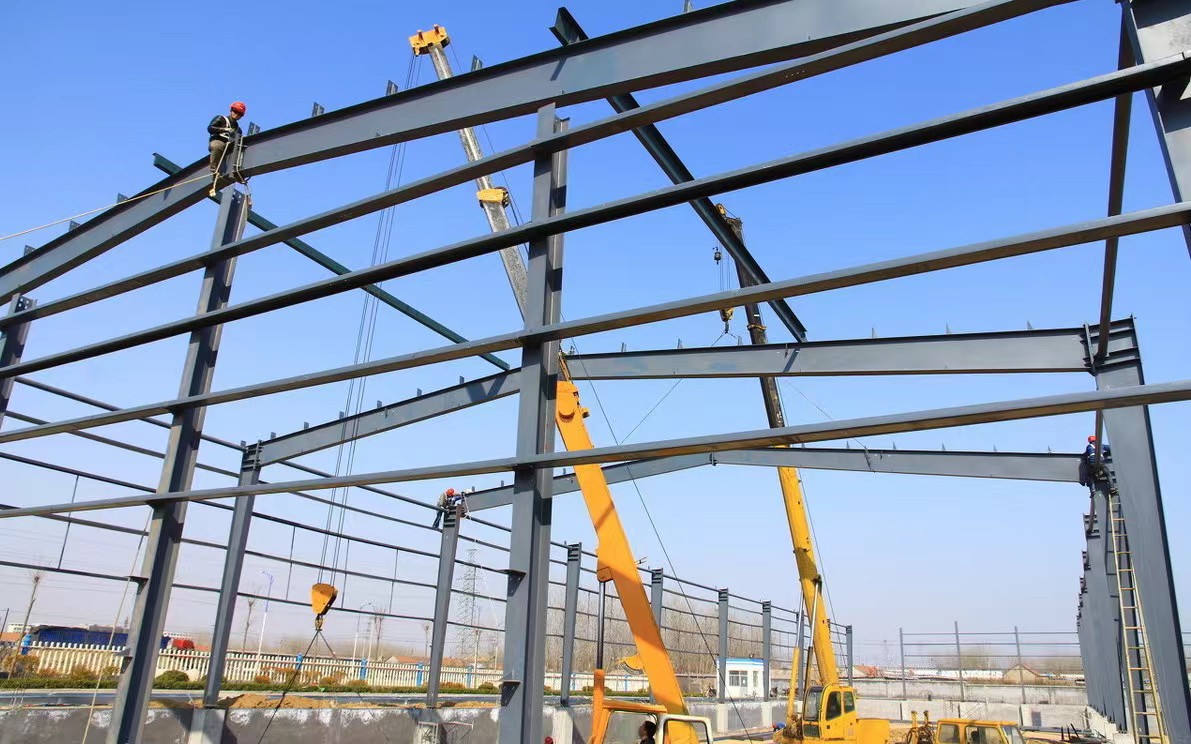
Portal steel structure is a widely used structural form in industrial and civil engineering, especially suitable for factory buildings, warehouses, garages, exhibition halls and other large-span buildings. It is composed of main frames (such as steel columns, beams), supports, purlins and enclosure systems, with unique structural characteristics and obvious application advantages. At the same time, its construction process has strong standardization and operability. This article will elaborate on the characteristics, advantages and specific construction steps of portal steel structure in detail.
The portal steel structure has distinct structural characteristics, which determine its wide application range and good performance. Firstly, it adopts a portal frame system as the core bearing structure. The main frame is usually composed of I-shaped steel, H-shaped steel or box-section steel, forming a door-like shape through rigid connections between columns and beams. This structure can effectively transfer the vertical load (such as self-weight, snow load) and horizontal load (such as wind load, seismic load) to the foundation, ensuring the overall stability of the building.
Secondly, it has excellent span adaptability. Compared with traditional reinforced concrete structures, portal steel structure can easily realize large-span design without setting intermediate columns, which greatly increases the usable space of the building. The span can generally reach 20-50 meters, and even larger spans can be achieved through optimized design.
Thirdly, the material utilization rate is high. The steel used in portal steel structure has high strength and good ductility. During the design process, the cross-section of components can be accurately calculated according to the load requirements, avoiding material waste. At the same time, steel components can be prefabricated in the factory with high processing precision and good quality control.
Fourthly, the structural form is flexible. Portal steel structure can be designed into different forms according to the actual needs of the building, such as single-span, multi-span, gable portal frame or shed portal frame. It can also be combined with other structural forms to meet the functional requirements of complex buildings.
Due to its unique structural characteristics, portal steel structure has many advantages in engineering application. Firstly, it has strong bearing capacity and good safety performance. Steel materials have high tensile strength and compressive strength, and the rigid connection of the portal frame makes the structure have good integrity and stability. It can effectively resist natural disasters such as earthquakes and strong winds, and the failure mode is ductile damage, which is conducive to reducing casualties and property losses.
Secondly, the construction period is short and the efficiency is high. Most of the components of portal steel structure are prefabricated in the factory, and only assembly work is required on the construction site. The prefabrication of components can be carried out in parallel with the site foundation construction, which greatly shortens the overall construction period. Compared with reinforced concrete structures, the construction period of portal steel structure can be shortened by 30%-50% generally.
Thirdly, it has good economic benefits. Although the initial investment in steel materials is relatively high, the advantages of short construction period, low labor cost, high material recycling rate and low maintenance cost in the later period make the comprehensive cost of portal steel structure more competitive. Especially for large-span and temporary buildings, the economic advantage is more obvious.
Fourthly, it is environmentally friendly and sustainable. Steel is a recyclable material, and the recycling rate of steel components in portal steel structure can reach more than 90%, which is in line with the concept of green building. At the same time, the construction process of portal steel structure produces less construction waste, low noise and little impact on the surrounding environment.
Fifthly, the maintenance is convenient. The surface of steel components is usually treated with anti-corrosion and anti-rust coatings, which have good durability. During the use process, only regular inspection and maintenance of the coatings and connections are required, and the maintenance work is simple and the cost is low.
The construction of portal steel structure needs to follow strict construction procedures to ensure the quality and safety of the project. The specific construction steps are as follows:
Firstly, carry out detailed design and drawing review. According to the functional requirements and site conditions of the building, complete the structural design of the portal steel structure, and organize professional and technical personnel to review the construction drawings to ensure the rationality and feasibility of the design. Secondly, do a good job in material procurement and inspection. Purchase steel materials, connectors, coatings and other materials that meet the design requirements and national standards, and conduct sampling inspection on the materials to ensure that the quality of the materials is qualified. Thirdly, carry out site preparation. Clean up the construction site, level the ground, set up construction enclosures and temporary facilities (such as construction offices, material warehouses), and ensure that the construction site has good transportation conditions and power supply and water supply guarantee.
The foundation of portal steel structure is usually a reinforced concrete independent foundation or strip foundation. Firstly, carry out geological survey on the construction site to determine the bearing capacity of the foundation soil. Then, according to the design drawings, carry out foundation excavation, and check the elevation and size of the excavation to ensure that it meets the design requirements. Next, bind the steel bars of the foundation, install the formwork, and pour the concrete. During the concrete pouring process, pay attention to the vibration and compaction of the concrete to ensure the strength of the concrete. After the concrete reaches the specified strength, remove the formwork and carry out foundation backfilling. Finally, install the anchor bolts on the foundation, and ensure the position accuracy and verticality of the anchor bolts, which is the key to the subsequent installation of steel columns.
Steel components (such as steel columns, beams, supports) are prefabricated in the factory. Firstly, carry out blanking of steel plates or section steels according to the design drawings. Use professional cutting equipment (such as flame cutting, plasma cutting) to cut the materials into the required size and shape. Then, carry out processing procedures such as edge planing, drilling and welding of the components. The welding work must be carried out by qualified welders, and the welding quality must be strictly controlled. After the welding is completed, conduct non-destructive testing (such as ultrasonic testing, radiographic testing) on the welds to ensure that there are no defects such as cracks and porosity. Finally, carry out anti-corrosion and anti-rust treatment on the steel components. The surface of the components is derusted first (such as shot blasting, sandblasting), and then painted with primer and topcoat to improve the corrosion resistance of the components.
Firstly, carry out the installation of steel columns. Hoist the prefabricated steel columns to the foundation by crane, align the bolt holes at the bottom of the columns with the anchor bolts on the foundation, and temporarily fix them with nuts. Then, use a level and theodolite to adjust the verticality and elevation of the steel columns, and tighten the nuts after meeting the requirements to fix the steel columns firmly. Secondly, carry out the installation of steel beams. Hoist the steel beams to the top of the steel columns, and connect them with the steel columns by high-strength bolts or welding. During the installation process, pay attention to the alignment of the steel beams and the tightness of the connections. For multi-span portal steel structures, install the steel beams span by span in sequence. Thirdly, install the support system and purlins. The support system (such as horizontal supports, vertical supports) is used to enhance the lateral stability of the structure, and the purlins are used to support the enclosure system. Install the supports and purlins in sequence according to the design drawings, and ensure that the connections are reliable.
The enclosure system of portal steel structure usually includes roof panels, wall panels, doors and windows. Firstly, install the roof panels. Lay the roof panels on the purlins, and fix them with self-tapping screws or rivets. Pay attention to the overlap between the roof panels to ensure good waterproof performance. Then, install the wall panels. Install the wall panels on the wall purlins in the same way as the roof panels, and cut the wall panels according to the position of doors and windows. Finally, install doors, windows and other components, and do a good job in sealing treatment around the doors and windows to prevent air leakage and water seepage.
After the completion of the entire portal steel structure construction, carry out comprehensive quality inspection. The inspection contents include: the position accuracy and verticality of steel columns and beams, the quality of welds, the tightness of high-strength bolt connections, the anti-corrosion and anti-rust effect of components, the installation quality of the enclosure system, etc. For unqualified items, timely rectify them. After the inspection is qualified, organize relevant units to carry out the completion acceptance. Only after the acceptance is passed can the building be put into use.
Portal steel structure has become an important structural form in modern engineering construction due to its characteristics of flexible structure, large span adaptability, high material utilization rate, as well as advantages of strong bearing capacity, short construction period, good economic benefits and environmental protection. In the construction process, strict adherence to the construction steps and quality control standards is the key to ensuring the safety and durability of the portal steel structure. With the continuous development of steel structure technology, the application range of portal steel structure will be more extensive in the future.

Copyright © 2023 Shandong Taida Steel Structure All Rights Reserved. XML Maps
Technical Support:Shandong Taida Steel Structure Co., Ltd
Scan to ChatHotline

![[lsit:title]](/static/upload/image/20230418/1681806890691293.jpg)
![[lsit:title]](/static/upload/image/20230418/1681799010587461.jpg)
![[lsit:title]](/static/upload/image/20230419/1681884718686743.jpg)